The Future of Work: Which Jobs Will AI Transform — or Replace?
Discover how AI is reshaping the job market in 2025. Analyze which sectors face automation risks, which will thrive, and explore the new careers AI is creating today.
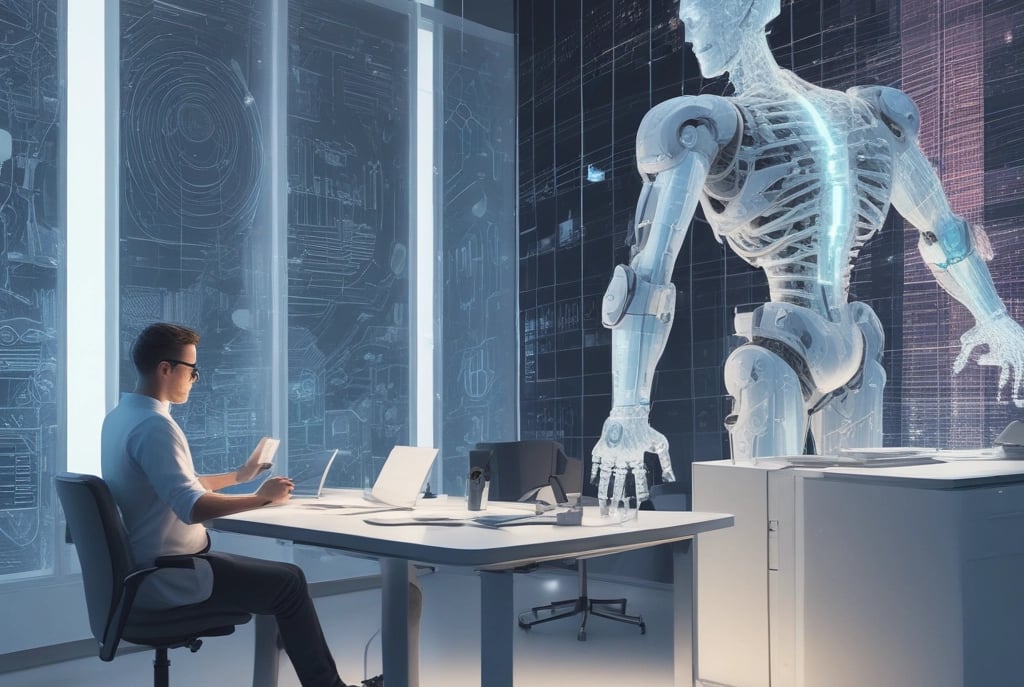
Discover how AI is reshaping the job market in 2025. Analyze which sectors face automation risks, which will thrive, and explore the new careers AI is creating today.
Introduction
For years, the headline has been terrifyingly simple: "Robots are coming for your job." But as we move deeper into the AI era, the reality is proving to be far more nuanced. AI isn't a monolith that devours employment; it's a tide that raises some boats while capsizing others. The question is no longer if AI will change work, but how—and who stands to gain the most.
In 2025, we are seeing a clear divergence. Routine, predictable tasks are being offloaded to algorithms at record speed. Meanwhile, roles that require complex empathy, strategic oversight, and physical dexterity are becoming more valuable than ever.
This article cuts through the fear-mongering to look at the data. We will identify the specific sectors facing genuine displacement risks, highlight the industries where AI is acting as a "super-assistant" rather than a replacement, and reveal the weird, wonderful new job titles that didn't even exist five years ago.
Sectors at Risk: The Automation Wave
The roles most vulnerable to AI displacement share a common trait: they involve repetitive information processing. It turns out that "white-collar" work is often easier to automate than manual labor because it happens entirely on a screen.
1. Administrative & Data Entry
Roles like data clerks, medical scribes, and basic bookkeepers are seeing significant contraction. AI tools can now listen to a doctor-patient conversation and transcribe perfectly formatted medical notes in seconds, reducing the demand for human scribes by up to 20%.
2. Basic Content Creation & Translation
Entry-level copywriting, stock photography, and routine translation services are being disrupted by generative models. Why pay for a generic blog post or a stock image when an LLM can generate one for pennies? The market for "average" content is collapsing, though the demand for high-quality, human-verified content remains.
3. Customer Support & Retail
Tier-1 customer support—the people who answer "Where is my order?"—is rapidly shifting to AI agents. These bots can handle thousands of queries simultaneously without fatigue. Similarly, automated checkout and inventory management are reducing the need for retail floor staff focused on logistics.
Sectors Benefitting: The Augmentation Boost
For many professions, AI is not a replacement but a jetpack. It handles the drudgery, freeing up humans to do the high-value work they were actually hired for.
1. Healthcare & Biotechnology
Doctors aren't disappearing; they are becoming "bionic." AI handles the paperwork and initial scan analysis, allowing physicians to spend more time on complex diagnoses and patient care. In drug discovery, AI models are simulating biological processes to identify potential cures years faster than traditional methods.
2. Software Engineering & Coding
Paradoxically, AI is making coders more productive, not obsolete. By automating the writing of boilerplate code and debugging, AI tools allow developers to focus on system architecture and creative problem-solving. The role is shifting from "writing code" to "orchestrating code."
3. Skilled Trades & Manual Labor
Plumbers, electricians, and nurses are largely safe from AI automation because their work is unstructured and physical. A robot cannot easily navigate a cluttered basement to fix a leak. In fact, AI is helping these trades by optimizing their schedules and managing their back-office logistics.
New Frontiers: Careers Created by AI
Just as the internet created "Social Media Managers," AI is birthing entirely new job categories. These roles often bridge the gap between human intent and machine logic.
1. AI Decision Designer
As companies let AI make high-stakes decisions (like approving loans), they need experts to design the framework for those decisions. These professionals blend ethics, psychology, and data science to ensure the AI isn't making biased or dangerous calls.
2. Synthetic Data Specialist
Real-world data is often messy or private (like medical records). These specialists create "fake" but statistically accurate data to train AI models safely, ensuring privacy laws are respected while models get smarter.
3. AI Ethicist & Governance Officer
With great power comes great liability. Companies are hiring governance officers to audit their AI systems for bias, ensure regulatory compliance, and protect the brand from "rogue" chatbots.
4. Prompt Engineer / AI Orchestrator
This role has evolved from "knowing how to ask ChatGPT a question" to designing complex workflows where multiple AI agents collaborate to solve business problems.
The "Human-in-the-Loop" Economy
The future of work isn't Human vs. AI; it's Human + AI. The most successful workers will be those who learn to treat AI as a colleague rather than a competitor. This "hybrid" model means that soft skills—negotiation, empathy, leadership, and strategic thinking—are becoming the new hard skills.
We are moving toward an economy where the premium is on judgment. AI can generate a thousand marketing slogans, but it takes a human to know which one will make a customer laugh. AI can diagnose a disease, but it takes a human to hold the patient's hand and explain the treatment options.
FAQ
1. Will AI replace all customer service jobs?
It will replace "transactional" support (checking balances, tracking orders), but "complex" support requiring empathy and problem-solving will likely remain human-led or hybrid.
2. Is coding a dead-end career now?
No. It is evolving. The demand for "pure" coding (typing syntax) may drop, but the demand for software architecture and system design is growing. Coders will become "AI supervisors."
3. What is a "Decision Designer"?
It's a new role focused on designing the rules and ethical guardrails for AI systems that make automated decisions, ensuring they align with human values.
4. Which blue-collar jobs are safe from AI?
Most skilled trades (electricians, plumbers, HVAC techs) are safe because they require fine motor skills and adaptability in unpredictable environments—things robots are still bad at.
5. How can I future-proof my career?
Focus on skills AI lacks: emotional intelligence, complex physical dexterity, and high-level strategic judgment. Learn to use AI tools to speed up your workflow.
6. Are creative jobs safe?
It's mixed. Low-level asset creation is at risk, but high-level creative direction and storytelling are arguably becoming more valuable as "human-made" becomes a premium label.
7. What is "Synthetic Data"?
It is artificially generated data that mimics real-world data. It's crucial for training AI in privacy-sensitive fields like healthcare without exposing real patient info.
8. Will AI increase inequality?
There is a risk. Workers who use AI effectively may see huge productivity and wage gains, while those who don't (or whose jobs are automated) could fall behind.
9. Do I need a degree to get an AI job?
Not necessarily for all roles. "Prompt Engineering" and operational roles often value practical experience and portfolio work over traditional computer science degrees.
10. When will these changes happen?
They are happening now. Reports suggest significant transformation by 2025-2030, with up to 60% of jobs requiring some level of retraining.
Conclusion
The narrative that "AI creates no jobs, only destroys them" is historically and statistically flawed. While the transition will be painful for specific sectors like data entry and administration, it is simultaneously unlocking a new tier of human potential.
The jobs of the future are not just about being smarter than the machine; they are about being more human than the machine. Whether you are a nurse using AI to catch symptoms early, or a "Decision Designer" teaching an algorithm ethics, your value lies in the unique, messy, wonderful human judgment that no code can replicate. The robots aren't taking over—they're just applying for the assistant position.