AI vs Human Creativity: Will Machines Replace Artists?
Explore the debate on AI vs human creativity. Will machines replace artists, or will they become the ultimate creative partner? Discover the future of art today.
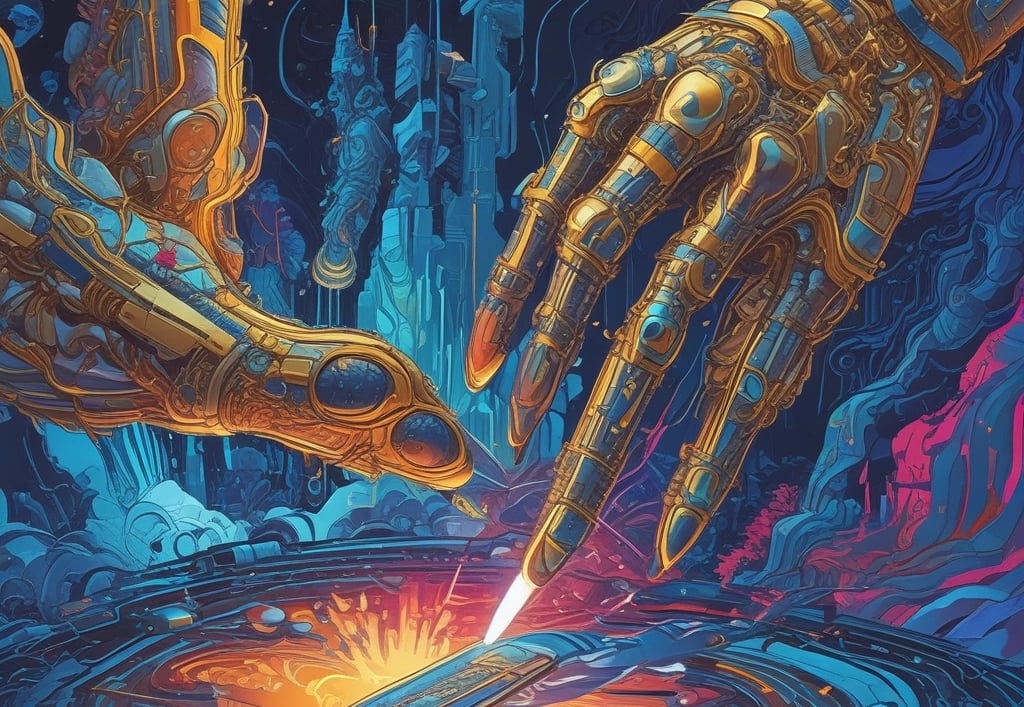
Explore the debate on AI vs human creativity. Will machines replace artists, or will they become the ultimate creative partner? Discover the future of art today.
Introduction
For centuries, creativity was the one fortress humans believed was impregnable. Machines could weave cloth, calculate trajectories, and even play chess, but they couldn't feel, and therefore, they couldn't create. Or so we thought. Today, tools like Midjourney, Suno, and ChatGPT are challenging that assumption, churning out novels, symphonies, and digital paintings that are often indistinguishable from human work.
This sudden explosion of "generative AI" has sparked a fierce global debate. On one side are the optimists, who see AI as a democratizing force that removes technical barriers and acts as a "force multiplier" for human imagination. On the other are the realists and skeptics, who fear widespread job displacement, the theft of intellectual property, and a flood of soulless content that drowns out authentic human voices.
In this article, we will look past the panic and the hype. We’ll examine real-world examples of AI in music, art, and storytelling to understand whether these tools are threatening originality or simply redefining it.
The Rise of the "Synthetic" Artist
We are witnessing the birth of a new kind of creator. In the visual arts, platforms like DALL-E 3 allow anyone to visualize complex concepts in seconds. Designers use these tools to rapid-prototype ideas that would have taken days to sketch by hand. In music, artists like Holly Herndon are pioneering "AI musicianship," using vocal clones to sing in languages they don't speak or harmonies they can't physically reach.
In literature, the shift is equally profound. Amazon is now flooded with books co-authored—or entirely written—by AI. Screenwriters use LLMs to break writers' block, generating plot twists or character backstories on demand. Even in gaming, AI is being used to generate infinite, non-repetitive dialogue for background characters, creating worlds that feel more alive than ever before. These aren't just parlor tricks; they are commercially viable products that are already reshaping the economy of creativity.
Collaboration vs. Replacement
The fear of replacement is valid. In highly technical or commercial fields—like stock photography, basic copywriting, or background animation—AI is indeed automating tasks that used to pay human wages. Why hire an illustrator for a blog header when a bot can make one for free in 30 seconds?
However, history suggests a different long-term outcome: evolution. Just as photography didn't kill painting (it just forced painters to move toward abstraction and expressionism), AI might push human artists toward deeper, more conceptual work. The "artist of the future" may act more like a director or a curator, guiding the AI to execute a vision rather than laboring over every brushstroke. The value shifts from technical execution (which AI is good at) to intent and taste (which remains uniquely human).
The Soul of the Machine (and What It Lacks)
Despite its technical prowess, AI has a glaring limitation: it has no lived experience. An AI can describe a broken heart in the style of Shakespeare, but it has never felt one. It can paint a sunset, but it has never stood in the cold waiting for the light to change.
This "emotional gap" is why AI art often feels technically perfect but emotionally hollow. Human creativity is often born from suffering, joy, limitation, and chaos—things AI models simply simulate based on data patterns. For audiences, the story behind the art often matters as much as the art itself. We value a song because we know the singer lived through the lyrics. AI cannot replicate that connection, no matter how high the resolution of its output.
Legal and Ethical Battlegrounds
The integration of AI into the arts isn't just a philosophical issue; it's a legal minefield. Most major AI models were trained on billions of images and texts scraped from the internet—often without the consent or compensation of the original creators. Artists are suing, arguing that AI is essentially a high-tech plagiarism machine that launders their style to compete against them.
Courts are currently struggling to decide: Is an AI-generated image "copyrightable"? (So far, the US Copyright Office says mostly "no"). Can an artist trademark a style? How do we pay royalties when a song is generated by an algorithm trained on the Beatles? The answers to these questions will define the economic landscape of the creative industries for the next century.
FAQ
1. Will AI replace professional artists?
It will likely replace tasks rather than entire professions. Commercial and technical roles (like generating generic assets) are at risk, but roles requiring high-level strategy, emotion, and intent will likely evolve rather than disappear.
2. Can AI create truly original ideas?
Not in the human sense. AI "creates" by recombining existing data in novel ways. While these combinations can be surprising and useful, they are ultimately derivative of the training data.
3. Is AI art considered "real" art?
This is subjective. Many argue that if a human guides the process and curates the result to express an idea, it is a valid artistic medium. Others see it as mere data processing.
4. How are musicians using AI?
They use it to separate tracks (stems), master audio, generate backing tracks, and even clone their own voices to harmonize with themselves.
5. What is the biggest ethical concern with AI art?
The primary concern is the non-consensual use of human artists' work to train the models, essentially using their own labor to build a tool that competes with them.
6. Can I copyright a book I wrote with ChatGPT?
Currently, US law states that content generated by AI cannot be copyrighted, but human-written content within the book can be. It's a grey area.
7. Does AI help with writer's block?
Yes, this is one of its most popular uses. Writers use it to brainstorm names, plot points, or alternative phrasings to get unstuck.
8. Will AI make human art more valuable?
Possibly. As AI floods the world with "perfect" synthetic content, authentic, human-made imperfections and stories may become a premium luxury good.
9. Are there tools to detect AI art?
Yes, but they are often unreliable. They can flag human art as AI and vice versa, making policing the boundary difficult.
10. How can artists survive in an AI world?
By leaning into what AI can't do: personal storytelling, emotional connection, community building, and high-level conceptual thinking.
Conclusion
The question "Will machines replace artists?" is perhaps the wrong one. Machines are certainly changing how art is made, just as the camera changed painting and the synthesizer changed music. But creativity is not just a product; it is a human function, a way of processing reality.
AI can mimic the result of creativity, but it cannot replicate the process of being human. The future likely belongs not to the machine alone, nor to the purist who rejects it, but to the "cyborg artist"—the creator who learns to wield this alien intelligence to tell deeper, stranger, and more resonant human stories.