Education 2030: How AI Tutors Are Reinventing Learning
Explore the classroom of 2030, where AI tutors personalize learning, automate grading, and empower teachers. Discover the benefits and ethical challenges of this educational revolution.
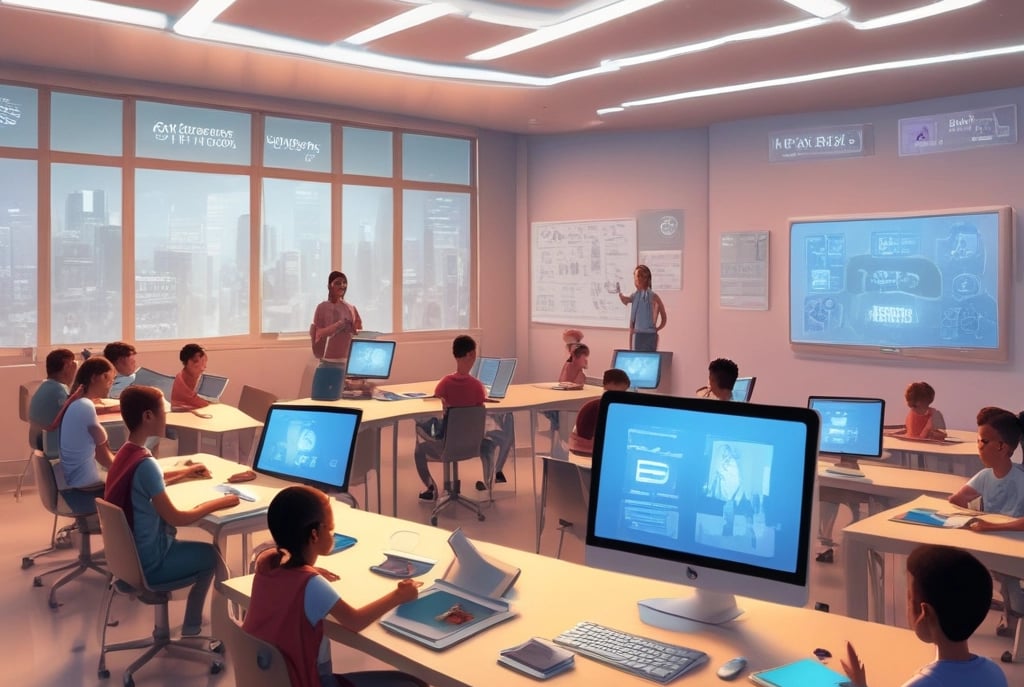
Explore the classroom of 2030, where AI tutors personalize learning, automate grading, and empower teachers. Discover the benefits and ethical challenges of this educational revolution.
Introduction
Imagine a classroom where no student is ever "left behind" because the curriculum adapts to their pace in real-time. Imagine a teacher who never spends a weekend grading quizzes, but instead spends that time mentoring students on complex projects. This isn't a sci-fi utopia; it's the projected reality of education in 2030.
As we approach the next decade, Artificial Intelligence is poised to dismantle the industrial model of education—where 30 kids sit in rows listening to the same lecture—and replace it with a hyper-personalized, adaptive ecosystem. AI tutors are rapidly evolving from simple chatbots into sophisticated "learning companions" that can explain quantum physics using soccer analogies or detect when a student is frustrated just by analyzing their typing speed.
In this article, we will unpack the three pillars of this transformation: personalized learning paths, automated assessment, and teacher augmentation. We will also confront the thorny ethical questions: What happens to student privacy? And does an algorithm-led education lose its human soul?
The End of "One Size Fits All"
The core promise of Education 2030 is personalization at scale. Today, a teacher creates one lesson plan for 30 diverse minds. By 2030, AI tutors will likely generate unique learning pathways for every single student.
If a student struggles with fractions, their AI tutor won't just repeat the definition. It might switch strategies, offering a visual simulation or a gamified challenge. If another student masters the concept in five minutes, the AI will immediately unlock advanced material, preventing boredom. This shift moves us toward "mastery-based learning," where students advance only when they truly understand a topic, not just because the semester ended. The result? A classroom where "falling behind" is technically impossible because there is no single "front" to be behind.
Automated Assessment: Grading Without Tears
Grading is often cited as the single biggest cause of teacher burnout. By 2030, the "Sunday night grading marathon" could be extinct. AI systems will likely handle the vast majority of formative assessments—quizzes, essays, and coding exercises—instantly and continuously.
But it goes beyond just marking answers "right" or "wrong." Advanced natural language processing (NLP) will allow systems to analyze how a student reached an answer. Did they use circular logic in their essay? Did they optimize their code efficiently? This provides students with "feedback loops" that are immediate and actionable, rather than waiting a week for a returned paper. Furthermore, standardized testing may decline in favor of "AI-curated portfolios," where the system tracks a student's growth over years, offering a far richer picture of their capabilities than a single exam ever could.
Teacher Augmentation: From Lecturer to Mentor
Will AI replace teachers? The consensus for 2030 is a resounding "no"—but it will change them. The role will shift from "Sage on the Stage" (delivering content) to "Guide on the Side" (facilitating growth).
With AI handling the delivery of facts and the grading of basic work, human educators can focus on high-value tasks that machines can't touch: social-emotional learning, conflict resolution, complex project management, and sparking motivation. Teachers will use "AI dashboards" to see a heat map of their class's emotional and academic state, allowing them to intervene precisely where needed. In this model, technology doesn't compete with the teacher; it gives them superpowers, enabling them to connect more deeply with each student.
The Ethical Report Card
Despite the optimism, the road to 2030 is paved with ethical potholes. The most pressing is data privacy. For an AI tutor to be effective, it needs to know everything about a student—their learning style, their struggles, maybe even their emotional state. Who owns this "digital twin"? If a private company controls the data, could it be monetized or used to deny future opportunities?
Then there is the risk of algorithmic bias. If an AI is trained on historical data where certain demographics underperformed, might it subtly steer those students toward less ambitious career paths? Finally, we must guard against human atrophy. If an AI is always there to "unstick" a student, do they ever learn the valuable skill of productive struggle? Balancing support with challenge will be the key pedagogical battleground of the next decade.
FAQ
1. Will AI tutors replace human teachers?
No. They will replace administrative tasks (grading, planning) and basic instruction, freeing humans to focus on mentorship and emotional support.
2. What is "mastery-based learning"?
It's a system where students move to the next topic only after they have mastered the current one, rather than moving at a fixed pace regardless of understanding. AI makes this scalable.
3. How will grading change?
It will move from "summative" (end-of-term tests) to "formative" (continuous, real-time feedback). Standardized tests may be replaced by digital portfolios.
4. Is my child's data safe with an AI tutor?
This is a major concern. By 2030, stricter regulations (like GDPR evolutions) will likely be needed to ensure student data is protected and not sold.
5. Can AI teach social skills?
Limitedly. While AI can simulate social scenarios, genuine empathy and collaboration are best learned through human-to-human interaction, facilitated by teachers.
6. Will this widen the "digital divide"?
There is a risk that rich schools get premium AI tutors while poor schools get basic ones. Governments must ensure equitable access to high-quality AI infrastructure.
7. What happens if the internet goes down?
Hybrid models will likely persist, but 2030 classrooms will rely heavily on cloud infrastructure. Offline AI models (running on local devices) are also in development.
8. Can AI detect if a student is cheating?
Yes, but the definition of "cheating" will change. Instead of banning AI, schools will likely test students on how well they can use AI to solve complex problems.
9. What subjects are best for AI tutoring?
Currently, STEM (math, coding) and languages see the biggest benefits. Humanities and arts are catching up as AI gets better at understanding nuance and creativity.
10. How personalized can it get?
Extremely. AI could theoretically adjust the tone of voice, cultural references, and pacing of a lesson to match a single student's personality perfectly.
Conclusion
Education 2030 promises a profound shift from "teaching to the middle" to "teaching to the individual." By offloading the cognitive drudgery of grading and lesson planning to AI tutors, we have the chance to make education more human, not less.
The success of this revolution won't be measured by how smart our machines become, but by how wise, compassionate, and capable our students become because of them. The future of learning is not about the software; it's about the freedom it gives us to focus on the heart of teaching.